The Social Order of the Underworld: How Prison Gangs Govern the American Penal System by David Skarbek
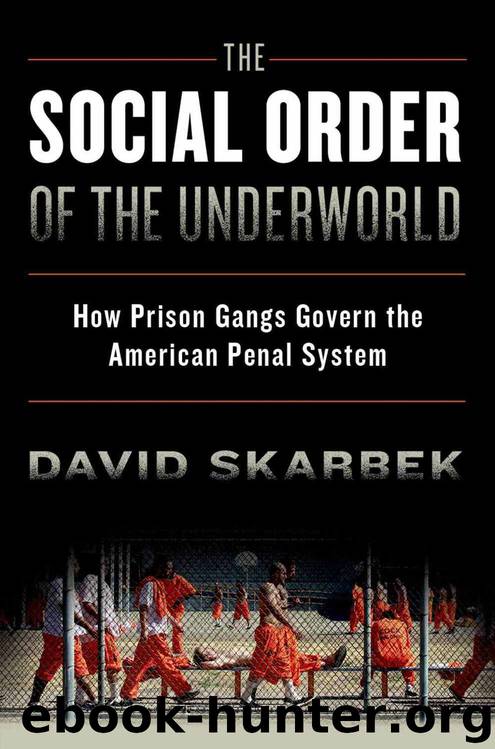
Author:David Skarbek [Skarbek, David]
Language: fra
Format: epub
Publisher: Oxford University Press
Published: 0101-01-01T00:00:00+00:00
The Internal Organization of Prison Gangs
111
Gangs must solve this trio of organizational challenges. If not, they will pour resources into inefficient endeavors and break up from within. These problems are interrelated, so improvement in one area can help with the others. If the gang recruits high-quality members, then there is less danger of them imposing costs on others. If they develop effective monitoring methods, then even if members are not of the highest quality, the gang can make them act properly. Successful gangs create internal structures that solve these related problems by generating information for people who have an incentive to use it to enhance the profitability of the gang. Often, gangs write these structures down in a criminal constitution.6
Putting the “Con” Into Constitutions
In nearly every type of organization, people find it useful to write down the rules. It helps to lay out clearly what each person in each position is authorized to do and is responsible for doing. New employees often receive manuals that tell them what they may, must, and must not do. These booklets detail what their job entails, who their boss is, and with what resources they will do their job. Employees learn how their supervisor will assess their work, the length of employment, and the consequences of doing a bad job. This is quite common. It happens in private companies, universities, non-profits, militaries, religious groups, and government bodies. It is tremendously helpful to make this information clear and explicit. Therefore, it should not surprise us that prison gangs do the same.
Constitutions define the rules of the game. They create the broad regulations that govern the daily interactions of people living under them. They often dictate the rules for how new rules will be made. They define how the group operates and how to change the rules that structure these activities.
Not all constitutions consist of a single written document. In the United Kingdom, for instance, the government relies on a common understanding of the principles derived from a number of documents, treatises, conventions, and legal precedents that constitute the key rules of the game. In the same way, prison gangs use both written and unwritten constitutions. For instance, some gangs reference a commonly understood “code of conduct” rather than a written parchment.
Criminal constitutions become known in several ways. Correctional officers find them during cell searches. One officer noted, “They used to make up these booklets that had rules in them. They’d pass them around and we’d confiscate them and they’d make more. They were very dedicated to making sure 112
the social order of the underworld
that everyone in the gang knows their own rules.”7 Retired correctional and law enforcement officers have written personal accounts that provide and discuss gang constitutions.8 Researchers and journalists working in and with correctional departments have also gained access to this information, through officials and informants.9 When an inmate drops out of a gang, he will tell staff about the gang’s organization. Law enforcement investigations can also reveal their inner workings. For example,
Download
This site does not store any files on its server. We only index and link to content provided by other sites. Please contact the content providers to delete copyright contents if any and email us, we'll remove relevant links or contents immediately.
| Anthropology | Archaeology |
| Philosophy | Politics & Government |
| Social Sciences | Sociology |
| Women's Studies |
Cecilia; Or, Memoirs of an Heiress — Volume 1 by Fanny Burney(32523)
Cecilia; Or, Memoirs of an Heiress — Volume 2 by Fanny Burney(31928)
Cecilia; Or, Memoirs of an Heiress — Volume 3 by Fanny Burney(31912)
The Great Music City by Andrea Baker(31894)
We're Going to Need More Wine by Gabrielle Union(19019)
All the Missing Girls by Megan Miranda(15882)
Pimp by Iceberg Slim(14461)
Bombshells: Glamour Girls of a Lifetime by Sullivan Steve(14036)
For the Love of Europe by Rick Steves(13792)
Talking to Strangers by Malcolm Gladwell(13327)
Norse Mythology by Gaiman Neil(13312)
Fifty Shades Freed by E L James(13214)
Mindhunter: Inside the FBI's Elite Serial Crime Unit by John E. Douglas & Mark Olshaker(9283)
Crazy Rich Asians by Kevin Kwan(9256)
The Lost Art of Listening by Michael P. Nichols(7475)
Enlightenment Now: The Case for Reason, Science, Humanism, and Progress by Steven Pinker(7287)
The Four Agreements by Don Miguel Ruiz(6726)
Bad Blood by John Carreyrou(6597)
Weapons of Math Destruction by Cathy O'Neil(6243)
